ANNA CLYNE
Born March 9, 1980, in London, England
This is the Wichita Symphony's first performance of “Restless Oceans.” Previously, the WSO played Anna Clyne’s “Masquerade” on October 26 and 27, 2019, with Daniel Hege conducting.
This concert kicks off with energetic foot-stomping—literally. Anna Clyne’s brief opening piece prompts the orchestra to make rhythmic accents with their feet and vocalizations. Such accents are more typical in dance, for which Clyne has composed several pieces. Using this physicality in orchestral music is effective and unlike anything most of the audience will have heard before at a symphony concert. After hearing the work, a critic for the New York Classical Review wrote,
“In its brief three minutes, what might be called a Fanfare for the Economic Woman offered thudding Rite of Spring-style rhythms, a tender flute melody over burbling winds, and a crescendo that was literally a hoot, with the players vocalizing, stamping their feet, and bounding out of their chairs at the final chord.”
Short works by contemporary composers fill a niche for orchestras seeking a concert opener that introduces audiences to new composers and innovative sounds. They have essentially replaced many of the standard concert overtures of the 19th century, which remained popular throughout the 20th century. Although Anna Clyne has experienced success with longer pieces, her concert openers, such as Restless Oceans and Masquerade, which we heard at the Wichita Symphony in October 2019, are frequently performed by orchestras worldwide. According to Boosey and Hawkes, publishers of Clyne’s music, since its premiere in 2019, Restless Oceans has been performed eighty-two times by nearly sixty orchestras. Masquerade, introduced in 2013, has 226 performances by over 120 orchestras.
Notable collaborations distinguish Clyne’s career. She has been commissioned and performed by a diverse group of leading ensembles and institutions, such as Carnegie Hall, the Los Angeles Philharmonic, the San Francisco Ballet, and the Metropolitan Museum of Art. Her partnerships with individuals include cellist Yo-Yo Ma, pianist Jeremy Denk, conductor Marin Alsop, and choreographer Pam Tanowitz. Her Concerto for Two Violins (2012), written for Jennifer Koh and Jaime Laredo, and recorded on the Cedille label, was nominated for the 2014 GRAMMY Awards in the category of Best Contemporary Classical Composition.
Program Notes by Don Reinhold © 2025
The composer’s website provides the following notes about Restless Oceans.
I composed Restless Oceans for Marin Alsop and the Taki Concordia Orchestra for performance at the World Economic Forum Annual Meeting in Davos. The piece received its world premiere at the opening ceremony in 2019, where Marin Alsop was presented with the Forum’s prestigious Crystal Award in recognition of her championship of diversity in music. This work draws inspiration and its title from A Woman Speaks, a poem by Audre Lorde (reprinted from Clyne’s website at the end of these notes), and was composed with this particular all-women orchestra in mind. In addition to playing their instruments, the musicians are also called to use their voices in song and strong vocalizations, and their feet to stomp and to bring them to stand united at the end. My intention was to write a defiant piece that embraces the power of women. Restless Oceans is dedicated with thanks to Marin Alsop.
A Woman Speaks - by Audre Lorde
Moon marked and touched by sun
my magic is unwritten
but when the sea turns back
it will leave my shape behind.
I seek no favor
untouched by blood
unrelenting as the curse of love
permanent as my errors
or my pride
I do not mix
love with pity
nor hate with scorn
and if you would know me
look into the entrails of Uranus
where the restless oceans pound.I do not dwell
within my birth nor my divinities
who am ageless and half-grown
and still seeking
my sisters
witches in Dahomey
wear me inside their coiled cloths
as our mother did
mourning.I have been woman
for a long time
beware my smile
I am treacherous with old magic
and the noon's new fury
with all your wide futures
promised
I am
woman
and not white.
Restless Oceans was recently recorded by Marin Alsop conducting the Baltimore Symphony Orchestra for the Naxos label. Listen to that recording on YouTube here: Restless Oceans
If you want to watch a video recording of a concert performance, here’s one by the Tapiola Sinfonietta where you’ll see foot-stomping and vocalizations.
(193) Anna Clyne: Restless Oceans - YouTube
FRANZ JOSEPH HAYDN
Born March 31, 1732, in Rohrau, Austria
Died May 31, 1809, in Vienna, Austria
The Wichita Symphony has performed Haydn’s C Major Cello Concerto three times, most recently on January 12 and 13, 2003, with cellist Wendy Warner and conductor Enrique Diemeke. The first performance was with cellist Lynn Harrell and conductor Michael Palmer on November 20 and 21, 1982.
The story behind Haydn’s C Major Cello Concerto is a tale of discovery and surprise – a genuine “Eureka! I’ve found it” moment. In 1961, Czech musicologist Oldřich Pulkert (1929–2016) found a facsimile of an unpublished score in an unknown handwriting for a cello concerto that seemed to date from the mid-18th century. Due to discoveries like this, scholars analyze such works to verify their authenticity and origin. In this case, the manuscript matched an incipit listed by Joseph Haydn in his catalog of music composed for the Hungarian Prince Esterházy. Nearly two hundred years after it was written, the concerto was identified as a “lost” C Major concerto by the renowned composer. At the time, Haydn biographer H. C. Robbins Landon called the find “the single greatest musicological discovery since the Second World War.”
Two hundred years earlier, in 1761, Haydn received his big professional opportunity when he was hired as Vice-Kapellmeister (Assistant Music Director) for the Esterházy court of Prince Anton Esterházy (1711–1762) in Eisenstadt, then part of the Habsburg Empire’s Kingdom of Hungary, now the capital of Austria’s Burgenland. The Esterházy Family was one of the wealthiest in the Empire and avid patrons of the arts, especially music. Although Haydn reported to the aging Kapellmeister Gregor Werner (1693–1766), who had managed the court’s music program since 1728, Haydn was assigned the essential responsibilities of overseeing the court orchestra and musicians, as well as chamber music, while being expected to compose most of the secular music needed for entertainment.
Determined to establish one of Europe’s leading orchestras, Prince Anton Esterházy recruited talented young Italian violinist Luigi Tomasini (1741–1808). Possibly following Haydn’s recommendations, cellist Joseph Weigl (1740–1820) and hornist Joseph Leutgeb (1732–1811) also joined the Esterházy orchestra in the early 1760s.* Notably, these were young men already recognized as the best players of their generation. To attract and retain them, Haydn composed music that highlighted their talents.
The Esterházy orchestra in the 1760s was excellent but much smaller than the one Haydn assembled during his time there. At that time, the Esterházy orchestra had four violins, one viola, one cello, one double bass, two oboes, and two horns. Haydn often conducted from the harpsichord, emphasizing the bass line and harmony.
The room where this music was performed was small, likely enough for about a hundred guests. The development of the grand Esterházy buildings, known as Esterháza and modeled after Versailles, took place after 1765 under Prince Nikolaus (1714–1790), the younger brother and successor of Prince Anton. This palace, designed as a summer residence on the shores of Lake Neuseidl, included a stunning concert hall and ballroom that could seat several hundred people and was among the best acoustically in Europe at the time. It featured a stage with space for more elaborate productions and a larger orchestra. Today, that hall is called the “Haydn Hall” in honor of the many works Haydn premiered there. Haydn worked for Nikolaus for nearly 30 years until Nikolaus's death.
The 1760s marked a turning point in music. Johann Sebastian Bach and George Frederick Handel, who elevated music to the glorious era known as the High Baroque of the early 18th century, had died in the previous decade. Their successors, including Bach’s sons Johann Christian and Carl Philipp Emanuel, rejected the complexities of the Baroque style, which featured ornate contrapuntal textures and embellished melodic lines. Instead, the younger generation adopted a more straightforward style, with melody as the primary focus. In mid-18th-century instrumental music, often called the early Classical era, exemplified by Haydn’s Cello Concerto, the melodic line in the violins or solo instrument takes precedence, with other instruments providing accompaniment and harmony.
Although Haydn’s service to the Esterházy princes often isolated him from current musical trends, as any exceptional composer would, he incorporated various styles into his musical language. The dramatic virtuosity in the middle of the first movement hints at the pre-romantic “Sturm und Drang” style of C.P.E. Bach. In contrast, the melodic second movement draws from the ornate Italian operatic tradition. The lively third movement demonstrates how the orchestral accompaniment features chords energized by repeated eighth notes that propel the music forward. It is a remnant of Baroque rhythmic energy but mostly lacks any real melodic interest, serving merely as accompaniment.
The structure of the Baroque concerto influenced Haydn’s concerto, especially in the ritornello form, where the main theme repeats and alternates with contrasting sections called episodes. In this format, the entire orchestra, known as the ripieno (R) or tutti, alternates with the soloist (S) sections. During the solo passages, the orchestra accompanies with little or no thematic exchange. Besides the solo cello, Haydn’s instrumentation for the C Major Concerto includes two flutes, two horns, and strings.
In Haydn’s concerto, each movement follows a pattern of R1 – S1 – R2 – S2 – R3 – S3 – R4. During Haydn’s ripieno sections, the violins carry the melody. Adding two oboes and two horns, which either double the violins or reinforce the harmony, enriches the orchestra's sound. When the solo cello plays, the oboes and horns (with some exceptions) drop out, leaving the strings to support the soloist. The thematic and motivic interaction between the orchestra and the soloist, seen in Mozart’s mature concertos, developed a few decades later. During Haydn’s early-Esterházy period, when multiple cellos were not used, the solo cello may also have played the double bass line in the ripieno sections, as shown in the full score. This role is no longer necessary with today’s larger orchestras. The difference between the virtuosic writing for the solo cello and the relatively plain bass lines played by the orchestral cellos is quite noticeable.
One notable feature of Haydn’s Cello Concerto is its duration of about twenty-four minutes. Most concertos from the earlier Baroque period, with some notable exceptions by J. S. Bach, last between seven and eighteen minutes. The three-movement fast-slow-fast structure remains a standard format.
The C Major Cello Concerto was likely composed and premiered between 1761 and 1765, although the exact date remains unknown. Cellist Joseph Weigl’s technical skill is evident throughout the concerto in Haydn’s demanding writing. Haydn fully utilizes the instrument's range. In particular, notice how the upper range penetrates through the accompaniment. Several times in the second and third movements, Haydn has the soloist hold a long note with a crescendo, creating the effect of the solo emerging from the orchestra.
After its debut, the concerto might have been performed several times before being forgotten. Composers working under noble patronage generally focused on creating new music for immediate use rather than for posterity. Once it served its purpose, music was often stored away without the detailed cataloging seen in modern library science. Since the music remained the property of the Esterházy family rather than the composer, this likely contributed to the score's loss. Losing scores and parts was not uncommon.^ The Hoboken catalog of Haydn’s works, compiled in the 20th century and partly based on Haydn’s notated catalog—possibly kept by Haydn to show his productivity to Esterházy—lists many lost pieces or even spurious compositions later identified as by others. Additionally, there’s a story that Haydn’s wife sometimes used her husband’s manuscripts to wrap fish! Sometimes, the fate of music is truly unknowable.
The modern premiere of the rediscovered concerto occurred on May 19, 1962, with cellist Miloš Sádlo and the Czech Radio Symphony Orchestra, conducted by Sir Charles Mackerras. Cellists, including Mstislav Rostropovich and Jacqueline DePré, quickly added the rediscovered concerto to their repertoires. Through performances and recordings, they elevated it to the top tier of popular cello concertos performed worldwide.
Haydn’s two cello concertos (the second in D major was composed in 1783, about twenty years after the C major) remain essential parts of the cello repertoire. In fact, the C Major Concerto might be one of the few pieces from the early Classical era of the 1760s that still appear on orchestral programs. It was written around the same time as Haydn’s early symphonies numbered 6, 7, and 8, which are occasionally performed by chamber orchestras but rarely by larger ensembles. Considering that Haydn composed 104 numbered symphonies, he was just beginning his prolific career as he entered his fourth decade. Other composers active in the 1760s, such as the Bach Brothers, Luigi Boccherini, and Giovanni Sammartini—both of whom wrote cello concertos—and Haydn’s Viennese peers Johann Christoph Monn and Georg Wagenseil might be heard occasionally on classical music stations like Radio Kansas, but rarely in concert halls, at least in the United States. Haydn’s Cello Concerto remains a unique glimpse into an often-overlooked decade in music history.
Enjoy this video recording on YouTube of the late great cellist Rostropovich and the Academy of St. Martin-in-the-Fields: Haydn, Cello Concert N°1 C Dur : Mstislav Rostropovich (cello)
* Tomasini, who was still a teenager when recruited by Prince Esterházy, would become an influential teacher, performer, and composer of violin works. Weigl went on to become a prominent cellist active in Viennese orchestras, and Leutgeb was the soloist for whom Mozart composed his horn concertos.
^ Haydn’s frequently performed Trumpet Concerto was another work that re-emerged in 1929, as did three of his violin concertos in the 20th century.
Program Notes by Don Reinhold © 2025
Learn More
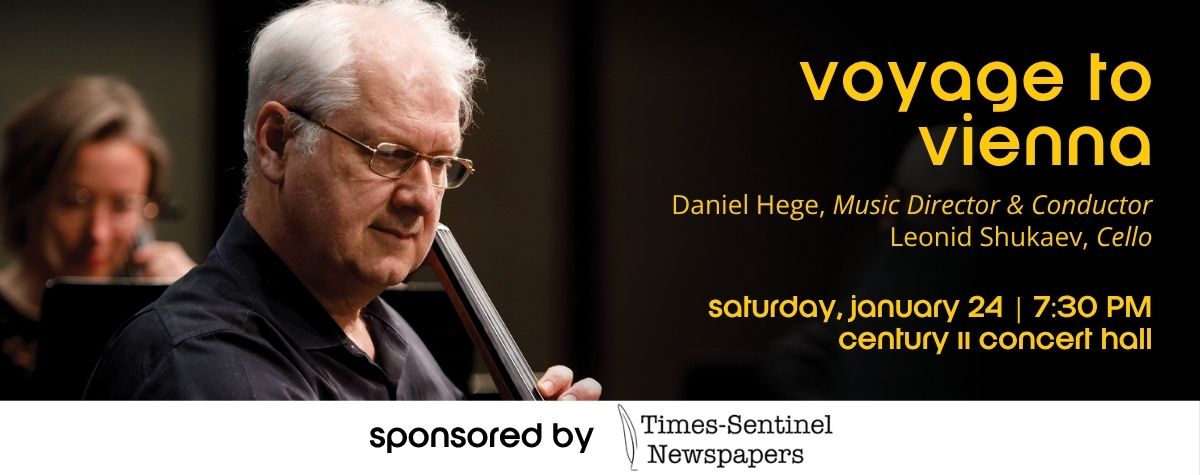
In this interview for the Wichita Symphony, Leonid Shukaev describes his background and his approach to performing the Haydn Cello Concerto. Read the interview here.
JOHANNES BRAHMS
Born May 7, 1833, in Hamburg, Germany
Died April 3, 1897, in Vienna, Austria
Returning from his summer holiday in the Styrian village of Mürzzuschlag in 1885, Brahms carried new music in his luggage. In a letter to conductor Hans von Bülow, Brahms mentioned that he had no luck with a third piano concerto but humorously noted that he had “a couple of entr’actes; put together they make what is commonly called a symphony.” Brahms knew high expectations awaited any new symphony, and he had doubts about his ability to match the success of his earlier acclaimed symphonies. Writing to his publisher, Simrock, Brahms admitted, “Taking it all in, I haven’t the ghost of an idea whether I’ll let the thing be published….You’d be insane to invest a groschen in it.”
In October 1885, Brahms gathered some of his closest friends for a preview of his new symphony in E minor, which he performed in a two-piano arrangement with his friend Ignaz Brüll. After the performance, the critic and Brahms supporter Eduard Hanslick remarked that it was “like being beaten up by two tremendously intelligent and witty people.” Max Kalbeck advised Brahms to discard the third movement, treat the fourth as a standalone piece, and compose two new movements. Elisabeth von Herzogenberg thought it was “intricate, intended for subtle and clever minds – not for simple lovers.”
Brahms took all this advice into account but chose to leave things unchanged, waiting for the first orchestra rehearsals scheduled later that month with von Bülow’s orchestra in Meiningen. Brahms believed that attitudes would change once his friends heard the new symphony in its orchestral form. He was right. Von Bülow recognized that the new symphony was exceptional. Acknowledging its difficulty, he described it as “overwhelmingly original, entirely new – with an individuality as firm as a rock. From first to last, marked by unparalleled energy.”
The premiere on October 25, 1885, with Brahms conducting the Meiningen Orchestra, was a success. A subsequent tour to nine German and Dutch cities featuring Brahms' symphony also gained widespread popularity and praise for the new work. However, when the symphony was finally performed in Vienna, the local audience’s reaction was different. Composer Hugo Wolf, who had his own agenda and was a vocal critic of Brahms, accused Brahms of mediocrity, claiming that “such nullity, emptiness, and hypocrisy as prevail in the E Minor Symphony have come to light in no other of his works. The art of composing without ideas has decidedly found its worthy representative in Brahms.” A witty remark set the tone for the opening with these words: “Es fiel…ihm wie…dermal…nichts ein.” (“Once again…he had…no ideas.”)
While history and audiences today recognize the Symphony in E minor as one of the greatest and most sublime 19th-century symphonies, it's not surprising that it was initially met with some hesitation. It is undeniably a complex piece to perform and fully understand. Designed as absolute music, it lacks a narrative story like those found in works by Berlioz, Liszt, and Wagner, which guide audiences through the music. It also largely lacks the colorful orchestral palette typical of Rimsky-Korsakov and Tchaikovsky. Brahms’s somber tone offers no uplifting message of hope or victory at the end, unlike Beethoven’s Ninth or Brahms’s earlier symphonies. In fact, one writer, Reinhold Brinkman, described the E minor Symphony as a “taking back” of the joyful message of Beethoven’s Ninth.
As audiences, how should we interpret the symphony? Beyond the rich string and wind textures, what should we listen for? The musicologist Alfred Einstein described Brahms as “the greatest representative of the musical Romantic movement, which sought to come to terms creatively with the past, unable to disregard Bach and Handel, Haydn and Mozart, and – above all – Beethoven.” To go beyond a vague feeling of "sadness" that we often associate with this work, it helps to understand that musical architecture, as seen in the great works of the Classical era, forms the foundation of Brahms’s compositional style. As we learn to recognize this structure, the deeper meaning of Brahms’s music reveals itself, leading us to a richer understanding.
The first movement, allegro non troppo (fast, but not too much), is a masterpiece of conciseness and the development of minimal materials, much like Beethoven's style. It demonstrates Brahms’ mastery as an architect of musical structure and form. The movement follows sonata form. According to a typical textbook formula, we expect an exposition that introduces two, possibly three themes, with harmonic movement from the tonic to the dominant. Here, our tonic or home key is E minor, and through harmonic progression, we might anticipate the harmonies eventually shifting to the dominant, B major. A development then occurs, where ideas from the exposition are elaborated, expanded, and contracted, with harmonic tension guiding us through several keys before returning to the home key of E minor. This return to the tonic signals a recapitulation—or repeat—of the opening exposition, often, but not always, with some additional development techniques. A coda, or concluding section, may follow the thematic restatement that happens in the recapitulation.
Once familiar with these basic structural elements, we can listen to Brahms and see how he creates a seamless, expressive, and fluid structure. Brahms is a composer who makes simple ideas go a long way. His building blocks include a two-note descending motif of a third that starts a series of falling intervals, which is countered by a two-note ascending motif. For those with some music theory knowledge, this initial ascending interval is a sixth, or the inversion of the descending third. After the theme’s first statement, Brahms quickly repeats it with a slight variation using broken octaves. This moment is striking in its orchestration. The back-and-forth interplay of the first and second violins is especially emphasized in stereophonic sound if the violins are positioned on the left and right of the conductor, as was common in Brahms’s era and still in many European orchestras. Unfortunately, most American orchestras place the first and second violins on the same side, which diminishes the effect.
The second thematic idea features a fanfare-like theme in the winds. With this fanfare, we have now reached the key of F-sharp major, a distant key from E minor, but as Brahms will clarify shortly, it is a detour that ultimately leads to E minor’s dominant key of B major. This fanfare introduces a striking rhythmic contrast to the opening. It includes a new triplet division of the measure introduced by the winds, followed by an answer from the full orchestra with a strong rhythmic profile. A passionate cello melody emerges, expanding on the opening two-note motive, now punctuated by the new rhythmic idea.
The arrival of B Major is marked by a new melodic idea introduced in the winds, where the contrast between duple and triplet subdivisions of the bar plays an important role. Beneath the melody, try to catch the staccato tapping of the accompaniment. It’s a variation of the opening two-note motivic idea. A mysterious arpeggiated chord in the strings interrupts the passage and injects harmonic ambiguity. For the first time in the symphony, the soft rumbling of the timpani conveys a sense of foreboding. The fanfare tune, with a more fully developed triplet rhythm, concludes the exposition.
At this stage, it is common in classical sonata form to repeat the exposition, returning to the opening bars, and we anticipate Brahms to follow this convention. However, a few bars into the repeat, Brahms alters a single chord, opening up a new spectrum of harmonic possibilities. It is only then that we realize we have heard a “false repeat” and that we are now in the middle of the development.
The development employs the ideas from the exposition to create tension. Imitation in the violins is paired with a new three-note pattern in the winds, which fills in or resolves the leaps caused by the original two-note motif. The accompaniment forms the foundation for a strong, march-like rhythm that moves forward through precise imitation between the upper strings and the rest of the orchestra. The mysterious chord once again interrupts the flow, and this time it combines with the fanfare theme. Brahms’ development of the triplet rhythm brings a renewed sense of urgency.
After expending his energy, Brahms brings the music to an almost complete halt in a remarkable passage that sets the stage for the return of the tonic key and the recapitulation. A one-measure sighing motive moves through the orchestra to different instruments over soft chords alternating between winds and strings. Finally, the oboes and bassoons play the opening notes of the symphony with greatly elongated note values while the strings whisper a sweeping arpeggio beneath them. Then Brahms resumes his original rhythm, and it becomes clear that we have reached the recapitulation. Brahms adds a coda of great urgency, featuring canonic imitation of the two-note motive between the low strings and horns against the upper strings, winds, and trumpets. The movement rushes toward its conclusion with a resounding “amen” cadence, culminating in a powerful close.
The second movement continues from where the first left off, featuring a strongly articulated theme centered on E. The harmony is somewhat ambiguous, giving the tune a ballad-like quality. Brahms employs an old church mode called the Phrygian scale, which is considered the most somber of the church modes. (If you have access to a piano, you can play a Phrygian scale by starting on the note E and playing only the white keys up to the next E an octave higher. It sounds a bit like a minor scale, except for the lowered second note that creates the modal effect.)
Richard Strauss, who was in Meiningen during the first rehearsals of the symphony, commented that the second movement “reminded him of a funeral procession moving in silence across the moonlit heights.” Elisabeth von Herzogenberg recognized that Brahms was revealing something of his inner self when she wrote to him, “[the second movement] has freshness and distinction of character with which only you could endow it. Even you have had recourse for the first time to certain locked chambers of your soul.”
The movement is, once again, in sonata form. Its architectural shape resembles an arch that peaks with rhythmic intensity during the brief development before resolving in a shortened recapitulation that ends quietly in E major. Like other slow movements by Brahms, this one also features a lush cello melody as the second theme. There is some beautiful wind writing, particularly in a cascading passage that begins with the flutes and falls through the clarinets to the bassoons.
For a brief moment, the sun shines in the third movement scherzo. For the first time, the timpani, now with a third drum, pounds away with a sense of joy, and Brahms adds a triangle for extra color. It’s a special splash of color and the only time Brahms uses a percussion instrument other than the timpani in any of his four symphonies. A strong rhythmic drive and some excellent orchestral effects mark the movement as Brahms plays the wind section against the strings. This movement received a “pop music treatment” in the 1970s when the rock band Yes recorded their version of the piece using synthesizers.
We finally arrive at the fourth movement. Tovey called it one of the greatest orchestral works since Beethoven. Jan Swafford writes, “The finale stands as Brahms’s most remarkable symphonic movement – most profound in craftsmanship, most wide-ranging in historical resonances, and most troubling….The finale of the Fourth Symphony is a technical tour de force in an archaic genre, expressed in terms of personal and cultural tragedy.”
Brahms's structure references the Baroque chaconne and passacaglia, where a series of variations is built on a repeating bass pattern and harmonic progression. As he did in the First Symphony, Brahms reserves his trombones for a key moment in the finale, and now we hear them for the first time alongside the other winds and brass as they play the eight-chord progression that serves as the finale's theme. Scholars have noted that the main theme closely resembles one of Bach’s chorale melodies. This theme serves as the basis for a series of 31 variations, in which the 8-note pattern is always present but sometimes hidden or embedded within the orchestral texture.
The way Brahms builds and releases tension, always keeping the music moving forward despite the limitations of a repeating pattern, is a work of genius. At a crucial point, the texture lightens, and a solo flute plays a poignant embellishment of the chaconne theme. In hesitant steps, it strives to become airborne, rising with the theme's shape, then falling back to earth over two octaves in a heart-rending admission of defeat. Several variations in E major follow, offering consolation. The trombones echo the chorale theme. The quiet moment of rest is interrupted by the return of the opening, almost as if Brahms wanted to remind us once more of the chaconne theme in a clear presentation. This time, it is accompanied by a descending string scale that adds an even greater degree of pessimism. Another sequence of variations on the chaconne theme follows. Similar to the first movement, Brahms frequently uses triplet patterns in conflict with duples to create tension and keep it constantly building. A coda bursts forth with the theme again over cascading strings, propelling it to its inevitable conclusion.
The Symphony in E minor was Brahms’s farewell statement in the symphonic form. As Tchaikovsky would with his Pathetique Symphony a decade later, Brahms leaves no doubt about the work’s tragic implications. Jan Swafford describes the symphony as a “funeral song for his heritage, for a world at peace, for an Austro-German middle class that honored and understood music like no other culture, for the sweet Vienna he knew, for his lost loved ones.” Brahms knew that he marked the end of a grand German lineage of composers. Although he would live for another decade, most of his compositional efforts would shift to song, small piano character pieces marked also by introspection, and several final chamber works.
Shortly before his death, Brahms made one last public appearance in Vienna at a performance of the Fourth Symphony. Weakened by liver cancer, the pale and frail composer stood in his box at the end of the symphony to accept the applause from an adoring audience who must have sensed the moment's finality. Standing on the cusp of a new century, perhaps the audience then understood the importance of this “elegiac symphony,” not just for the dying Johannes Brahms but also for themselves, their century, and a cultural era.
Whether this is your first time or one of many over a lifetime, the Fourth Symphony is a challenging work that rewards familiarity and repeated listening. You can “warm up” for the concert experience or continue your journey afterward with this performance by the Cleveland Orchestra conducted by Franz Welser-Möst, one of many available on YouTube.
Brahms - Symphony No. 4 in E minor, Op. 98 (Cleveland Orchestra, Franz Welser-Möst)
For a nostalgic moment, Rick Wakefield arranged the third movement of the Fourth Symphony for his rock band, Yes. The band included it on their 1971 album Fragile. Here’s a YouTube recording. It sounds very outdated now, but in the early 1970s, using cutting-edge synthesizers, it had a notable “cool” factor among many young adults.
Cans and Brahms (Extracts from Brahms' 4th Symphony in E Minor, Third Movement) (2008 Remaster
Notes by Don Reinhold, © 2025
Don is the retired CEO (2012–2024) of the Wichita Symphony. He holds degrees in piano and music history from Bucknell University and the University of North Carolina at Chapel Hill. He also studied piano at the Salzburg Mozarteum and the University of Maryland, College Park, where he coordinated the University’s International Music Festivals and Competitions for piano, cello, and voice. In 1988, he founded the National Orchestral Institute, an advanced training program for aspiring orchestral musicians. NOI, as it's fondly known by participants, has helped young musicians prepare for and succeed in professional auditions for orchestras around the world, including the Wichita Symphony. The program continues today under the leadership of internationally acclaimed conductor Marin Alsop and director Richard Scerbo.
|
Please upgrade

Internet Explorer
|
or try one of these other browsers.
Browsers are free and easy to install.
|
||||
| Upgrade Internet Explorer | What's a browser? Opt out |