RICHARD WAGNER
Born May 22, 1813, in Leipzig, Germany
Died February 13, 1883, in Venice, Italy
The Wichita Symphony has performed The Flying Dutchman Overture four times in its history. The most recent performance was on March 15 and 16, 2008. Grant Cooper conducted on that occasion.
The subject of “flying” informed the construction of this program. We begin with a supernatural sea captain condemned to “fly” over the waves for eternity. The program continues with the premiere of a concerto that evokes birdcalls that surround us in nature, and concludes with a mythical figure, a bird that helps break a spell of dark enchantment.
The story of The Flying Dutchman is rooted in folklore and the supernatural, capturing the darker themes of German Romanticism while evoking the realism of stormy seas as Wagner remembered them during his voyage from Riga (now in Latvia) to London to escape his creditors. Wagner wrote the opera's libretto himself, drawing on elements from a novel by the German Romantic poet Heinrich Heine and from the German Romantic opera tradition established by Carl Maria von Weber in works such as Der Freischütz (1821).
Abandoning the sprawling five-act format of his previous opera, Rienzi (1839), Dutchman is a tightly constructed three-act opera.The story centers on a sea captain, the Dutchman, doomed to sail the stormy seas forever for blasphemous statements and actions from earlier in his life. He can only escape this purgatory by finding a pure, young woman who will remain faithful unto death. To seek a savior, he’s allowed to dock every seven years in search of his redemptive love. This is where the opera begins. He encounters a merchant sea captain who speaks of his daughter, Senta. The Dutchman offers the captain a bribe to gain an introduction. Senta and the Dutchman meet. One thing leads to another; declarations of love follow, and the Dutchman believes he’s found his salvation. In Act 3, he overhears one of Senta’s young suitors making his case and mistakenly feels betrayed. He orders the sails of his ship raised and, with his doomed crew, sets sail for the open seas. Except (spoiler alert), Senta, seeing this, declares her love, climbs a cliff, and hurls herself into the sea. The Dutchman’s ship immediately strikes a rock and sinks. The opera ends with the souls of Senta and the Dutchman ascending to heaven – redemption achieved.
Wagner composed the Overture after completing the opera. It introduces the principal musical themes of the story that follows (much like many overtures to Broadway musicals do in the 20th century). In this work, Wagner introduces the concept of a leitmotif (leading motive), associating a brief musical idea with a specific character or action.
The Overture begins with one of the finest depictions of a stormy sea in the entire orchestral repertoire. Mendelssohn’s Calm Sea and Prosperous Voyage Overture (1828) and his Hebrides Overture (1830) are among the earliest 19th-century attempts to depict the sea, works Wagner likely knew. Yet Mendelssohn’s depictions are rather polite and benign compared with the tumultuous surge and ferocity Wagner captures.
Against a forte tremolo in the high strings, the horns introduce the Dutchman’s motif. This triadic outline, like a hunting horn call, foreshadows the motifs that would be prominent in Wagner’s later Ring cycle. Chromatic scales in the low strings lead to crashing diminished chords. With these surging chromatic scales in the strings and forte chords in the orchestra, we easily imagine the depiction of a roaring sea and crashing waves against the rocks on shore.
The music pauses after a soft timpani roll on A, the dominant in D minor, with the cadence softly articulated in the lower strings. A new theme emerges in the sunnier key of F major (the relative major) and at a slower tempo (andante). Played by the English horn and echoed by the oboes and clarinets, this gentle theme represents Senta, the young woman who will become the Dutchman’s redemption. As this brief interlude concludes, listen to the musical effect as the orchestra evokes gentle lapping waves, set against the chromatic descent of trombone chords and the Dutchman’s motif in the horns. So much of the story, as it begins, is told in these few elements.
The sea's turbulence returns, and we hear chromatic scales and crashing chords once again. Now, the motifs of the Dutchman and Senta co-mingle, adding urgency. Eventually, Wagner introduces a new jaunty theme, a sailor’s hornpipe dance that contrasts with the storm music and the developing interaction between the Dutchman and Senta’s motifs.
As the music progresses over a continuation of the storm music, the key motifs of the Dutchman, Senta, and the sailors’ dance battle for supremacy. It is a musical struggle among the human world, the supernatural, and redemptive love.
As the piece reaches its climax, Senta’s motif asserts itself as it strains upward to overcome the Dutchman’s curse. In his original 1841 version of the Overture, Wagner ended the music abruptly, assuming the opera would tell the rest of the story. In 1860, he revised the Overture, adding a few bars to the end to capture the moment when, in a moment of redemptive love, Senta’s motif wins the day and ascends to heaven. In this final version, the Overture stands well on its own in a concert setting as a programmatic work that conveys the essence of the story.
The Flying Dutchman was Wagner’s first opera, marking the beginning of his path toward creating musical dramas known as Gesamtkunstwerke, or total artworks. Wagner’s vision for opera was to create works that fuse music, poetry, and visual spectacle in an unprecedented way. He composed two earlier operas (1833 and 1834), closer in style to Rossini, and a third, Rienzi (1839), in the grand opera style of Meyerbeer. These are now entirely forgotten, except for occasional performances of the Overture to Rienzi. Even Wagner, in his autobiography, recalled being unsure of his artistic abilities at age 30.
The Flying Dutchman was composed in 1840 and 1841 while Wagner resided in Paris. Although he later denied the influence, Wagner was impressed by Berlioz’s Romeo and Juliet, in which choral movements alternated with instrumental ones to create a dramatic symphony. By 1842, Wagner had moved to Dresden, where, after the premiere of Rienzi, he was appointed Royal Court Kapellmeister. The following year, he produced the premiere of The Flying Dutchman.
Wagner’s Overture to The Flying Dutchman is scored for a piccolo, two flutes, two oboes (one doubling on English horn), two clarinets, two bassoons, four horns, two trumpets, three trombones, a tuba, a timpanist, a harpist, and the orchestral strings.
Before attending the concert, check out these videos of The Flying Dutchman Overture on YouTube.
Sir George Solti leads the Chicago Symphony Orchestra in this one:
Wagner Der fliegende Hollander Overture Solti
Or, Marek Janowski conducts the Frankfort Radio Symphony here:
Wagner: Der fliegende Holländer – Ouvertüre • hr-Sinfonieorchester • Marek Janowski
Program Notes by Don Reinhold © 2026
DAN PERTTU
Concerto Fieldnotes from the Composer
Chapter 1: Dawn’s Chorus
The concerto opens with a delicate violin solo, imitating the soft melodies and chirps of early morning birds. As the orchestra gradually awakens, individual instruments interject, creating the layered, vibrant soundscape of a forest at first light. The violin leads the narrative, weaving through textures, borrowing fragments of avian calls, and translating them into a distinctly human musical language. Birds represented: Wood Thrush, Great Horned Owl, American Robin, Eurasian Blackbird
Chapter 2: The Canyon’s Whisper
From the innocence of dawn, the music deepens into a mysterious, expansive terrain. Resonant brass form the echoing canyon walls as the violin evokes the haunting call of a lone wolf reaching across the landscape to its distant pack. Percussion adds depth and distance, reinforcing the vastness of the canyon. Birds represented: Canyon Wren, Rock Wren, Bullock’s Oriole, Pinyon Jay, Turkey Vulture.
Chapter 3: Eagles’ Soar
A broad, noble violin solo rises, embodying the effortless glide of bald eagles soaring above the canyon. The orchestra responds with sweeping gestures and open harmonies, mirroring the power and freedom of flight. Descending arpeggios in quick succession echo the bald eagle’s chortling call, celebrating both majesty and command. Birds represented: Bald Eagle.
Chapter 4: Crows’ Dance
The music turns darker and more playful. Crows and ravens emerge, characterized by intelligence,
mischief, and social complexity. The violin weaves playful, sometimes biting motifs amid fluttering woodwinds and restless strings. Rhythms fracture and recombine, reflecting the asymmetrical hopping gait and layered personalities of these birds—sarcastic, curious, sweet, and persistent. Birds represented: American Crow, Common Raven.
Chapter 5: Confluence
All elements converge in a sweeping finale. Birdsong, canyon echoes, and the expansive flight of bald eagles intertwine as the violin gathers and transforms material from each chapter into a unified whole. The movement opens with the Wood Thrush and passes through the White-Throated Sparrow, Chickadee, and Blackbird before arriving at the bright, rhythmic, joyful call of the Cardinal. Birds represented: Wood Thrush, White-Throated Sparrow, Black-Capped Chickadee, Eurasian Blackbird, Northern Cardinal.
Footnote:
The Mexican Grey Wolf and canyon sounds in the concert are included to highlight ecological interconnections. The wolf’s call traversing the canyon emphasizes the relationships between species and landscapes, echoing the interconnectedness and symbiotic relationships of the natural world that inspired this concerto.
Why the Mexican Grey Wolf is in a concerto about birds
The Mexican Grey Wolf was chosen for this concerto not only for its ecological significance but for the musical qualities of its howl. Unlike a simple signal, the wolf’s call carries long, modulated pitches that resemble a song, full of tone, rhythm, and natural phrasing. These vocalizations communicate across the canyon while expressing individuality, creating a melody that inspired the violin lines in Chapter 2. By incorporating the wolf’s howl, the music highlights both the connections within the natural world and the inherent musicality found in animal communication, emphasizing that nature itself is a source of song.
Program Notes by Dan Perttu © 2026
IGOR STRAVINSKY
Born June 17, 1882, in Oranienbaum, near St. Petersburg
Died April 6, 1971, in New York City
1. Introduction – Prelude and Dance of the Firebird – Variations (Firebird)
2. Pantomime I
3. Pas de deux: Firebird and Ivan Tsarevich
4. Pantomime II
5. Scherzo: Dance of the Princesses
6. Pantomime III
7. Rondo (Khorovod)
8. Infernal Dance
9. Lullaby (Firebird)
10. Final Hymn
The Wichita Symphony previously performed The Firebird Suite eight times, most recently on April 9 and 10, 2011, with Daniel Hege conducting. These performances were likely of the 1919 Suite, for which the Symphony has owned a set of parts. This concert may be the first time the Symphony performs the 1945 Suite, for which parts have been rented.
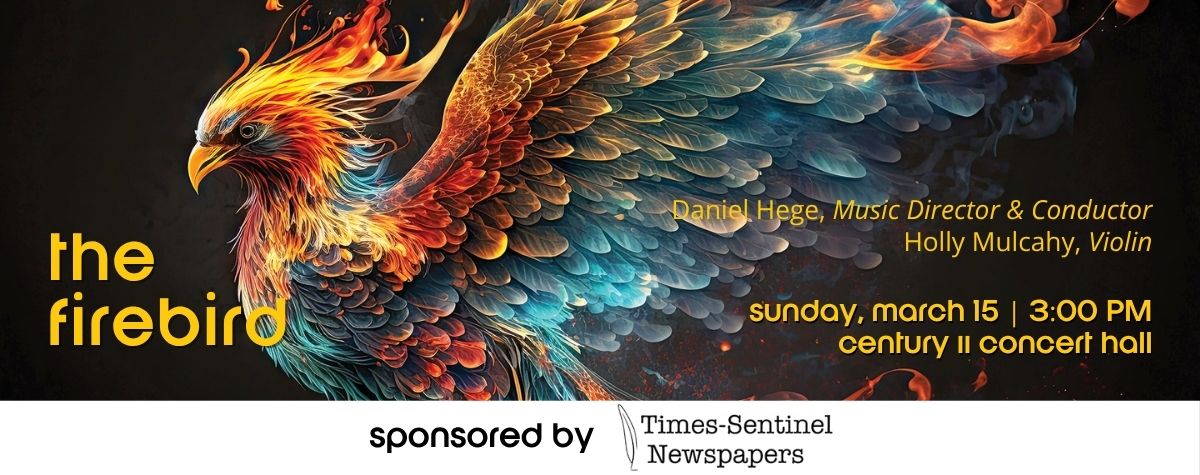
For ballet impresario Serge Diaghilev (1872-1929), time was of the essence. The Paris opening of the 1910 season of his Ballet Russes was approaching, and he had in hand an important new ballet scenario by the choreographer and dancer Mikhail Folkine (1880-1942). Based on the mythological Russian folk creature the Firebird, this would be the first major commission on a Russian subject for his company, which he founded in 1909. Diaghilev envisioned a comprehensive Russian art movement that would embrace all artistic disciplines.
What he didn’t have was the music! He had approached three or four students of Nikolai Rimsky-Korsakov (1844-1908), all of whom had established reputations, but each declined the assignment for various reasons. As a last resort, he turned to the young, unproven composer Igor Stravinsky, who had also been trained by Rimsky-Korsakov. Stravinsky had impressed Diaghilev with his short, colorful orchestral work Fireworks (1908) and had provided Diaghilev with additional orchestrations of Chopin’s piano music for a production of Les Sylphides. He may not have been the first or second choice, but he got the job!
Stravinsky, who later claimed the ballet required the kind of descriptive music he didn’t want to write, accepted the commission and completed the ballet’s piano score in about three months, finishing it by March 21. He finished the orchestration six weeks later, by May 1910, in time for the premiere of The Firebird on June 25, 1910, in Paris. The ballet was a stunning success, and Stravinsky went from an unknown, provincial Russian composer to a European celebrity overnight. Diaghilev claimed The Firebird was the first nationalist Russian ballet, noting that Russian subjects had not been part of the imperial ballet tradition in Russia, as represented by Tchaikovsky. A year later, Claude Debussy wrote in an article, “Last year, a young man composed for his debut a ballet, The Firebird … Well, this work was an exquisite and original piece.”
Seeking to capitalize on his success and good fortune, Stravinsky arranged an orchestral suite of several dance scenes in 1911 that could be performed by orchestras in a shortened version of the ballet and without dancers. This version proved cumbersome because it retained the large orchestra and quadruple winds of the complete ballet. Recognizing that many orchestras lacked enough musicians, Stravinsky began reorchestrating sections as early as 1914. Following the Russian Revolution of 1918, when his copyright ownership of the Suite was disputed by the Russian publisher, Stravinsky completed the Second Suite in 1919, adding a couple of dances and deleting others from the 1911 Suite. It was also scored for a smaller orchestra. While this Second Suite also encountered copyright issues, it became the version orchestras turned to and continue to use today.
The Suite we hear at this concert was arranged and reorchestrated by Stravinsky in 1945, shortly before he became an American citizen. Copyright laws were lax and inconsistent between countries at the time, so this new Suite placed The Firebird back under copyright, ensuring that Stravinsky would benefit from his intellectual and artistic property. Stravinsky worked from a pirated Kalmus edition of the 1919 Suite (the version owned by orchestras, including the Wichita Symphony) and his copy of the complete ballet score. For this version, he retained the dances of the Second Suite but inserted several of the ballet’s brief Pantomime passages (numbers 2, 4, and 6 in the program). Since The Firebird ballet combines moments of mime with dance, these Pantomime sections are the equivalent of an opera’s recitatives, providing transitions between dances.
Stravinsky maintained the same instrumentation as his 1919 Firebird Suite, adding only a snare drum. The orchestra for the 1945 Suite consists of two flutes plus piccolo, two oboes, two clarinets, two bassoons, four horns, two trumpets, three trombones, and one tuba. The percussion section includes timpani, bass drum, cymbals, snare drum, tambourine, triangle, and xylophone. The orchestra also includes a harp and piano, plus the usual strings.
The 1945 Suite premiered at the Metropolitan Opera House on October 24, 1945, with Jascha Horenstein conducting. Stravinsky conducted Firebird many times throughout his career, including one of his final appearances as a conductor on January 18, 1967, in Los Angeles. That performance was also his final recording.
The sequence of movements in the 1945 Suite closely mirrors the ballet’s storyline. The Firebird’s narrative is a fairy-tale struggle between good and evil. An evil sorcerer named Kashchey the Deathless holds thirteen princesses captive, and guards an enchanted garden filled with trees that bear golden apples; The garden also contains stone statues that were Kashchey’s enemies, whom he turned to stone with his sorcery.
A noble Prince, Tsarevich Ivan, enters the scene in search of the Firebird (#1), a prominent figure in Russian folklore. The prince chases the Firebird into Kashchey’s garden and manages to capture her. The Firebird pleads for her freedom (#3), which she is granted, and in gratitude, she bestows Ivan with a magical, protective feather.
The thirteen princesses emerge from the castle to dance and play games in the garden (#5). Ivan falls in love with the youngest, and they perform a slow circle dance called a Khorovod (#7). Trumpets sound, summoning the princesses back into the castle. Ivan tries to follow them, but Kashchey blocks him at the gate. Before Kashchey can turn Ivan into stone, Ivan summons the Firebird with the magical feather. The Firebird appears and, through her magic, forces Kashchey and his minions into the Infernal Dance, whipping them into a delirious frenzy (#8). Eventually, they fall exhausted into a deep sleep, lulled by the gentle tones of a lullaby (#9).
The Firebird instructs Ivan to retrieve the magic egg containing Kashchey’s evil soul and destroy it. He does so, freeing the princesses and the stone figures from their enchantments. A triumphant celebration and wedding between Ivan and the young princess conclude the story (#10). Presumably, everyone lives happily ever after.
The music of Firebird brings together Russian musical traditions with forward-looking elements that anticipate Stravinsky’s future path. In some ways, he’s adapting different musical styles, as Rimsky-Korsakov did in his late operas, which often deal with fairy-tale subjects.
The Firebird’s human characters are portrayed with folkloric and melodic qualities, as well as a sense of harmony, reminiscent of late 19th-century Russian music. Stravinsky even borrows folk tunes from Rimsky-Korsakov’s collection of 100 Russian Folksongs, Op. 24. You’ll hear these folksongs in the oboe solo of the Rondo (#7) and in the main theme of the Final Hymn (#10), where the solo horn introduces the folksong.
On the other hand, the parts of the story featuring fantastical characters (the Firebird and the sorcerer Kashchey) use chromaticism and a kaleidoscope of colors that splash and interject throughout the music. Stravinsky may be drawing on lessons from Scriabin’s music in these moments. The rhythms of the Infernal Dance (#8) reflect not only the interest in musical barbarism during the first decade of the 20th century but also anticipate Stravinsky’s methods for The Rite of Spring (1913).
While listening to The Firebird, one of the most striking features is the orchestration. As a student of Rimsky-Korsakov, who wrote one of the important treatises on orchestration, Stravinsky mastered the techniques and used the instruments’ tone colors (timbres) to tell the ballet’s story. A few examples bear mention. At the very beginning (Introduction), note how the low strings (muted violas, cellos, and basses) plus a soft roll on the bass drum create the atmosphere of a dark and foreboding forest. The woodwinds, with clipped rhythms, suggest the Firebird flitting from branch to branch. Abruptly, the Firebird’s presence becomes prominent as it dances (Dance of the Firebird and Variations). Notice the effect of the woodwinds. Their music is not melodic in a traditional sense but consists of gestures over the pecking rhythm of the strings.
The duet (Pas de Deux, #3) between the Firebird and the Prince is known for its exotic and sinuous chromatic passages, particularly in the oboe.
Listen for the piano's colorful effects throughout and for how Stravinsky exploits the instrument for its impressionistic color and percussive qualities. The piano's use within the orchestra was still novel at the time. Stravinsky would give the piano a leading role in his next ballet, Petrushka (1911).
Following their success with Firebird, Diaghilev and Stravinsky would collaborate on two of the 20th century’s most famous ballets, Petrushka and The Rite of Spring. After World War I, they continued their partnership with Pulcinella (1920) and Les Noces (1923). Stravinsky would compose a dozen ballets throughout his career, including an important partnership with George Balanchine. As Stravinsky wrote in 1911, “I love ballet and am interested in it more than anything else.”
If this is your first time listening to The Firebird, you might want to listen to it before attending the concert. Here is a performance conducted by Teodor Currentzis at the Vienna Concert Hall. The orchestra is the Utopia Festival Orchestra, a special project of the conductor that brings together musicians from leading European orchestras for special performances. With this YouTube video, you’ll be able to follow along with the full score (don’t worry if you can’t), but it may give you some appreciation for the complexities a conductor like Daniel Hege must manage during a live performance like the one you’ll hear on March 15.
Stravinsky: ‘The Firebird’ Suite (1945) · Teodor Currentzis — Full Score
Following the publication of the 1945 Firebird Suite, which renewed Stravinsky’s copyright, his publisher, Leeds, allowed a foxtrot arrangement of the “Dance of the Princesses”. This appropriation, titled “Summer Moon,” sparked a new dispute over ownership rights. Stravinsky sued Leeds, complaining about the arrangement by “these vulgar Broadway people,” but he lost in court. Take a trip down Memory Lane and listen to this 1947 recording of “Summer Moon” by Harry James and His Orchestra. Lou Singer is credited with the arrangement, and John Klenner with the lyrics.
Summer Moon - Harry James & Vinni De Campo, 1947 (adapted from Stravinsky’s Firebird)
Program Notes by Don Reinhold © 2026
Don is the retired CEO (2012–2024) of the Wichita Symphony. He holds degrees in piano and music history from Bucknell University and the University of North Carolina at Chapel Hill. He also studied piano at the Salzburg Mozarteum and the University of Maryland, College Park, where he coordinated the University’s International Music Festivals and Competitions for piano, cello, and voice. In 1988, he founded the National Orchestral Institute, an advanced training program for aspiring orchestral musicians. NOI, as it's fondly known by participants, has helped young musicians prepare for and succeed in professional auditions for orchestras around the world, including the Wichita Symphony. The program continues today under the leadership of internationally acclaimed conductor Marin Alsop and director Richard Scerbo.
|
Please upgrade

Internet Explorer
|
or try one of these other browsers.
Browsers are free and easy to install.
|
||||
| Upgrade Internet Explorer | What's a browser? Opt out |