Wichita Symphony
By Don Reinhold
This is the Wichita Symphony’s first performance of Overture. Previously, the WSO performed Montgomery’s Starburst (September 2019 and November 2025) and Rounds for Piano and String Orchestra (March 2023).
An award-winning composer, Jessie Montgomery’s music interweaves classical music with elements of vernacular music, improvisation, poetry, and social consciousness.
Composer Joan Tower describes Jessie Montgomery’s music as “a blend of references that intertwine in a cohesive way.”
Overture is a study in orchestral texture and color, offering layers of contrast that culminate in a radiant C major harmony.
Since we last encountered Jessie Montgomery's music with the Wichita Symphony, her career has continued to flourish. Musical America named her Composer of the Year in 2023. She won a GRAMMY® Award in 2024 for Rounds for Piano and String Orchestra, the work we heard in 2023. Performance Today named her Classical Woman of the Year in 2025. She completed a three-year residency with the Chicago Symphony in 2024 and began a residency at the Curtis Institute of Music. Orchestras worldwide perform her symphonic works. She is developing an opera for the Metropolitan Opera.
Jessie Montgomery was born and raised on Manhattan’s Lower East Side in the 1980s, when the neighborhood was gaining a reputation for cultural activity and growth. She studied violin at the Third Street Music Settlement and graduated from Juilliard in 2003 with a degree in violin performance. She later completed a graduate degree in Composition for Film and Multimedia at New York University in 2012. She is a doctoral candidate in music composition at Princeton University.
At the heart of Montgomery’s work is a deep commitment to community enrichment and a desire to create opportunities for young artists. During her tenure at the Chicago Symphony Orchestra, she launched the Young Composers Initiative, which supports high school-aged youth in creating and presenting their works through regular tutorials, reading sessions, and public performances. Since 1999, she has been affiliated with the Sphinx Organization in various roles, including serving as Composer-in-Residence for the Sphinx Virtuosi, its professional touring ensemble.
Montgomery composed Overture during her Chicago Symphony residency. She describes the work as “a one-movement orchestral tutti steeped in harmonic textures inspired by a fusion of jazz and American classical harmonies, Baroque rhythmic gestures, and polyphonic tension.” In a New York Times interview, Montgomery expands on the concept of blended styles, explaining:
I have this idea in my mind that there’s something beyond fusion. There’s this other sound I’m going for that is a culmination, like the smashing together, of different styles and influences.”
How helpful Montgomery’s description of the music will be depends on your prior listening experience and your ability to relate to the elements she describes. She makes it sound complicated, even though the piece is rather simple.
The opening two minutes are written for strings alone. High, piercing repeated notes (Cs) create a strident backdrop for unison motivic and chromatic gestures. The music is marked “boldly,” and the accented pitches are to be played “relentlessly” and “sustained.” The dynamic level is loud (forte). The music then moves to a passage of dynamic contrasts between soft and loud, with sudden (subito) shifts to soft and very soft, followed by a crescendo back to loud.
The strings are eventually joined by the rest of the orchestra about two minutes into the piece. Here, the strings become more animated at a slightly faster tempo, contrasting with the winds and brass, which sustain chords that swell in crescendo and decrescendo. Occasional chromatic melodic gestures in the winds and brass echo the strings' activity. Trills on many notes in the flute, piccolo, and strings create a buzzy sound.
The music returns to the opening tempo, with the high-string tones returning, now amplified by the woodwinds. The juxtaposition of high and low tones creates a sense of space and tension. The music remains mostly loud until the end, when it finally opens onto a radiant C major chord that resolves the music’s dissonance and sustains to the end.
The orchestration for Overture includes a piccolo, two each of flutes, oboes, clarinets, bassoons, horns, trumpets, and trombones, plus timpani and strings.
Overture has not yet been commercially recorded, but you can listen to a performance by the Chicago Symphony Youth Orchestra on YouTube from their November 20, 2022, concert at Chicago’s Orchestra Hall. Allen Tinkham is the conductor.
Tchaikovsky’s First Piano Concerto, one of the world’s most beloved piano concertos, has been performed twelve times by the Wichita Symphony. The most recent performance was with Joyce Yang on January 26 and 27, 2019, conducted by David Lockington. Several of the great mid-20th-century pianists performed the concerto in Wichita, including William Kapell (February 1948), John Browning (January 1958), Van Cliburn (February 1962), and André Watts (October 1971).
Tchaikovsky’s First Piano Concerto features one of the most recognizable openings in classical music. The melody was even adapted into the popular 1941 song "Tonight We Love."
Tchaikovsky was not a professional pianist, yet he managed to load his concerto with a multitude of virtuosic fireworks and technical challenges.
While most wouldn’t recognize them today, Tchaikovsky’s concerto quotes a couple of Ukrainian folk songs and a French vaudeville tune that would have been familiar to his Russian audience.
For at least one generation of Americans, Tchaikovsky’s First Piano Concerto evokes memories of the 23-year-old Van Cliburn winning the inaugural International Tchaikovsky Piano Competition in Moscow at the height of the Cold War in 1958. The Soviets intended the competition to demonstrate their cultural superiority, but Cliburn won over the audience and the jury with spellbinding performances. Returning home to a hero’s welcome and a New York City ticker-tape parade, Cliburn became the darling of America’s classical music world. His recordings of both the Tchaikovsky and the Rachmaninoff Third Concerto made the bestseller lists and entered the homes of many American families, for whom these concertos became an important introduction to classical music. Four years later, the Wichita audience would welcome Van Cliburn for a reprisal of the Tchaikovsky concerto.
America’s love affair with Tchaikovsky’s Concerto dates to the 19th century, when, by a quirk of fate, the work received its world premiere on October 25, 1875, at Boston’s Music Hall, later known as the Orpheum Theater on Washington Street. Hans von Bülow, the renowned pianist, conductor, and former son-in-law of Franz Liszt, served as soloist, and B.J. Lang conducted freelance musicians, mostly from the Harvard Musical Association, a predecessor of the Boston Symphony. The performance was a triumph, despite a Boston Globe critic who doubted the concerto would earn a permanent place in the repertoire.
How the concerto ended up on von Bülow’s piano rack is an oft-told tale. Not a professional virtuoso pianist, Tchaikovsky had once vowed never to attempt a piano concerto. Nonetheless, he took on the task and composed it at a feverish pace in November and December 1874. Seeking the advice, and hopefully the praise, of Nikolai Rubinstein, the famous conductor, pianist, and director of the Moscow Conservatory, to whom Tchaikovsky wished to dedicate the work, Tchaikovsky played through the concerto for Rubinstein on Christmas Eve. In a letter to his patron, Mme. von Meck, Tchaikovsky recounts that Rubinstein sat in stony silence throughout the entire piece. At the concerto’s conclusion, Tchaikovsky entreated Rubinstein for comment. Tchaikovsky’s own words tell it best:
“Then a torrent poured from Nikolai Grigoryevich’s mouth, gentle at first, then growing more and more into the sound of Jupiter the Thunderer. It turned out that my concerto was worthless and unplayable; passages were so fragmented, so clumsy, so badly written that they were beyond rescue; the work itself was bad, vulgar; in places I had stolen from other composers; only two or three pages were worth preserving; the rest must be thrown away or completely rewritten…. The chief thing I can’t reproduce is the tone in which all this was delivered. In a word, a disinterested person in the room might have thought I was a maniac, an untalented, senseless hack who had come to submit his rubbish to an eminent musician….”
Stung by Rubinstein’s critique, Tchaikovsky rejected Rubinstein’s suggestions, declaring he wouldn’t “alter a single note” and would “publish the work exactly as is.” The concerto’s premiere and dedication then went to von Bülow, who had recently given a piano recital in Moscow and had praised Tchaikovsky’s music in a review the previous year. Von Bülow, who was about to embark on an American concert tour, packed the new score in his luggage and played it several times during the tour.
The American public received the work favorably, and it quickly entered the standard repertoire of the newly formed Boston Symphony Orchestra and other American orchestras. Following advice from several colleagues, Tchaikovsky revised the concerto in 1879 and again in 1888, making adjustments, particularly to the piano part. Interestingly, the crashing piano chords we’ve come to know in the work’s introduction were not part of the original 1874 version but were added in 1888, possibly at the recommendation of pianist Alexander Siloti. Originally, Tchaikovsky wrote arpeggiated chords for the piano to accompany the melody played by the strings.
The concerto was featured during the inaugural week of concerts in May 1891 at New York City’s beautiful new Music Hall (renamed Carnegie Hall in 1894), with Tchaikovsky himself on the podium. The German-born pianist and composer Adele aus der Ohe performed at that Music Hall concert. She also played the work at the final concert Tchaikovsky conducted in Russia, where he premiered his Sixth Symphony in October 1893.
Today, Tchaikovsky’s First Piano Concerto is among the most performed and beloved piano concertos. As for Nikolai Rubinstein, he, too, eventually came around to the piece and performed it in 1878. He subsequently helped popularize it by conducting it and teaching it to his students.
The appeal of Tchaikovsky’s First Piano Concerto lies in its abundance of melodies, passion, and keyboard fireworks. The concerto opens with one of the most famous introductions in classical music. This sweeping melody, with its crashing piano chords, has won audiences’ hearts ever since. Notably, the opening brass fanfares are in B-flat minor, the key signature of the work’s title. But a few measures in, as the big chords appear, Tchaikovsky presents his big tune in D-flat major, the relative major of B-flat minor. This fluidity of tonal centers will be a hallmark of the concerto.
The introduction lasts about four minutes and contrasts with the lighter allegro con spirito and the main exposition that follows. People have long wondered why Tchaikovsky would squander such a great opening tune, using it only in the introduction and never returning to it. Francis Maes notes that the motivic relationship between the introduction and the rest of the concerto is subtle, but the relationships between the motives and those of the quoted songs serve as unifying devices for the work’s structure. In the 1940s, the introductory tune was adapted into the pop song “Tonight We Love” by Freddy Martin.
Tchaikovsky offers us other melodies of great appeal throughout the concerto. Still influenced by Russian nationalist composers, especially Mily Balakirev (1837 – 1910), Tchaikovsky quotes Ukrainian folk songs in the first and third movements. The second movement is distinguished by a lovely opening flute melody and a middle section that is a rollicking scherzo-waltz, adapted from a French cabaret song from the vaudeville La corde sensible (Heartstring, 1851), which ran in St. Petersburg. Tchaikovsky had a brief “crush” on the actress who sang the song. The strong, muscular character of the third movement, with its Cossack dance-like rhythms, is contrasted by another melody of romantic breadth. In the final statement of this tune in full orchestral regalia near the end, one recognizes the climax model that would later be used with great success by Rachmaninoff in the finales of his 2nd and 3rd Piano Concertos.
For someone who was not a professionally trained pianist, Tchaikovsky employs a full range of virtuosic techniques and challenges for the soloist, including fistfuls of blocked chords, rippling arpeggios, and flying octaves. He also demonstrates his mastery as an orchestrator, using a full range of soloistic colors. However, for all of the bravura, Tchaikovsky never strays far from his lyrical operatic background while anticipating the balletic masterpieces still to come.
Tchaikovsky’s concerto is scored for solo piano, two flutes, two oboes, two clarinets, two bassoons, four horns, two trumpets, three trombones, timpani, and strings.
After winning the 1958 Tchaikovsky Competition, Van Cliburn (1934 – 2013) made Tchaikovsky’s concerto a calling card throughout his career. Here’s a remarkable concert recording from Moscow in 1962, four years after the Competition. Kirill Kondrashin conducts the Moscow State Philharmonic Academy Orchestra.
Van Cliburn - Tchaikovsky Piano Concerto No. 1, B-flat minor
There are many recordings of Tchaikovsky’s concerto to choose from. Here’s one featuring Martha Argerich, with Charles Dutoit conducting the Verbier Festival Orchestra in 2014.
Tchaikovsky: Piano Concerto No. 1 | Martha Argerich, Charles Dutoit & the Verbier Festival Orchestra
For your nostalgic listening pleasure, here’s Freddy Martin’s 1941 hit adaptation of the opening of Tchaikovsky’s concerto, “Tonight We Love,” featuring Clyde Rogers’ smooth vocals.
1941 HITS ARCHIVE: Tonight We Love - Freddy Martin (Clyde Rogers, vocal)
Or this souped-up version of the song for an orchestra:
Freddy Martin and His Orchestra - Tonight We Love
You can cringe and bear it, I suppose!
Shostakovich’s Fifth Symphony was viewed as an attempt to rehabilitate his reputation with Soviet authorities, given that he was living dangerously and in fear for his life.
Shostakovich stated that most of his symphonies were “tombstones,” heard as memorials not only to his compatriots who fell in WWII but also to those who were victims of Josef Stalin’s murderous policies.
Shostakovich’s music is laden with dark, mournful qualities as well as biting, satirical wit. It raises the political issue of how music can be heard in multiple interpretations, by state authorities on the one hand and by the general population, who heard and understood veiled references, on the other.
On January 28, 1936, Dmitri Shostakovich’s world collapsed. Two days earlier, Josef Stalin had attended a performance of Shostakovich’s internationally acclaimed opera Lady Macbeth of Mtsensk District. Stalin hated it and walked out before the final act. On January 28, a scathing article appeared in Pravda, the Communist Party newspaper. Titled “Muddle Instead of Music,” it denounced Shostakovich’s music, specifically the opera Lady Macbeth. The highly political article clearly bore Stalin’s stamp. It condemned the opera for its “coarse, primitive and vulgar” music. A thinly veiled threat warned that Shostakovich was “playing at abstruse things, which could end very badly.”
Shostakovich never saw it coming. How could he? The Soviet Union hailed him as its greatest living composer and a hero of the people. This acclaim stemmed from a string of successes, most notably the opera Lady Macbeth, based on a story by Leskov. Completed in 1932, the opera premiered in Leningrad in 1934 and ran thirty-six times. It enjoyed even greater success in Moscow, with ninety-four performances over two seasons. Beyond Soviet borders, international audiences applauded productions in Stockholm, Prague, London, Zurich, Copenhagen, and New York City. Who would have predicted that Stalin would hate it?
No sooner had the Pravda article appeared than those who had recently acclaimed Shostakovich as a Soviet hero turned against him. A meeting of the Leningrad Union of Composers dragged on for several days. As remembered by Shostakovich’s friend, Isaak Glikman, and quoted in Elizabeth Wilson’s excellent Shostakovich – A Life Remembered, “the harrowing discussion was unsparing and hard-hitting. It transpired that there were many who lost no time in practicing their rhetorical skills and were all too happy to trample the disgraced opera in the mud.” Overnight, Shostakovich had gone from “hero” and “genius” to “enemy of the people.”
Deeply chastened, Shostakovich said little until his Fifth Symphony premiered in Leningrad on November 21, 1937. The American premiere followed on April 9, 1938, with Artur Rodzinski conducting the NBC Symphony.
The Soviet press hailed the new symphony: “A work of such philosophical depth and emotional force could only be created here in the USSR.” The symphony was “an offering to the shrine of socialist realism.” Shostakovich was commended for his personal reformation and for the “heroic classicism” embodied in the music. For those who remembered life under the Tsar, the symphony might have been seen as portraying the proletariat’s sufferings, battles, and ultimate victory. Audiences were told that the work was “a Soviet artist’s creative reply to just criticism.”
In America, many critics and college professors argued that Shostakovich was little more than a Communist Party apparatchik and a pliable voice for Party leaders. One important history of 20th-century music, published in America in the mid-60s, called him “a heroic spokesman for his country” and offered a superficial rundown of his important works, acknowledging that he had suffered several rebukes from Soviet officials. Some American professors as late as the early 70s bemoaned that it was a talent that, sadly, didn’t follow through on the success and promise of the First Symphony.
Reevaluation of Shostakovich began a few years after his death in 1975, when Solomon Volkov smuggled out what were reputed to be Shostakovich’s memoirs and published them as Testimony. Volkov claimed that Shostakovich was a secret dissident and a yurodivy, a person who “has the gift to see and hear what others cannot” and who communicates these truths in code. Testimony sparked intense debate over the merits and authenticity of Volkov’s account. Richard Taruskin, Laurel Fay, and Elizabeth Wilson each wrote major books that significantly contributed to the discussion.
Throughout his life, Shostakovich was reticent about assigning meaning to his music, often for reasons of personal safety. Largely through Volkov, we became aware of possible ideas Shostakovich might have harbored. In Testimony, Shostakovich is quoted as saying, “Of course they understood. They understood what was happening around them and they understood what the Fifth was all about.”
After the infamous Pravda article appeared, Shostakovich carried on, declaring to his friend Isaak Glikman, “Even if they chop off my hands, I will still continue to compose music, even if I have to hold the pen in my teeth.” And so he composed, completing his Fourth Symphony in the spring of 1936. However, during rehearsals for the new work, pressure and threats from the authorities mounted, and Shostakovich withdrew the work from performance, publicly declaring his dissatisfaction with it.
Shostakovich was not the only one to endure extreme hardship in Stalin’s Soviet Union. 1936 marked the beginning of Stalin’s “reign of terror” and the Great Purge, which would arrest more than seven million people over the next three years. Millions were executed or simply disappeared into the gulags. Some of them were among Shostakovich’s closest friends and family. In Volkov’s Testimony, Shostakovich said, “The majority of my symphonies are tombstones. Too many of our people died and were buried in places unknown to anyone, not even their relatives. It happened to many of my friends. Where do you put the tombstones for Meyerhold or Tukhachevsky? Only music can do that for them. I’m willing to write a composition for each of the victims, but that’s impossible, and that’s why I dedicate my music to them all.”
To understand what this was like, one need only read in Wilson’s book the frightening account by Benjamin Basner of Shostakovich’s friendship with Marshall Mikhail Tukhachevsky, one of the Soviet Union’s greatest military strategists and a strong advocate for Shostakovich’s music. Shostakovich had even sought Tukhachevsky’s advice after the Pravda editorial appeared.
In 1937, Tukhachevsky was arrested and charged with plotting against Stalin. Shostakovich was summoned by the authorities and questioned about his friendship with the Marshall. Insisting that their conversations had been only about music, Shostakovich was given the weekend “to remember everything” and told to report back for interrogation on Monday morning. After a weekend spent straightening his affairs as best he could, Shostakovich returned as instructed, only to discover that his own interrogator had been arrested and imprisoned over the weekend. Thus, Shostakovich was spared. As for Tukhachevsky, he became one of Stalin’s victims and was executed as “an enemy of the people.”
In Testimony, Solomon Volkov writes: “Like many other people at the time, [Shostakovich] kept a small suitcase packed and ready. They usually came for their victims at night. Shostakovich did not sleep. He lay listening, waiting in the dark.” How could this fear not affect Shostakovich’s music? Shostakovich tells us, “Awaiting execution is a theme that has tormented me all my life. Many pages of my music are devoted to it.” In this context of terror, fearing for his life and probably perilously close to the edge, Shostakovich composed his Fifth Symphony.
* * * * *
The symphony is scored for a large orchestra: two flutes, piccolo, two oboes, three clarinets, two bassoons, contrabassoon, four horns, three trumpets, three trombones, tuba, harp, and strings. The percussion section includes timpani, bass drum, cymbals, triangle, snare drum, tam-tam, xylophone, bells, celesta, and piano.
The first movement is in sonata form. Like Mahler, Shostakovich’s themes contain multiple ideas that contribute to larger architectural blocks. The first and second themes of the first movement are similar, each featuring an alternating series of an ascending interval followed by a descending interval. The first theme initially thrusts forward with an abrupt, disjunct, and accented dotted-rhythmic figure. This, in turn, becomes part of an accompanying figure for a more lyrical melody that also contains the dotted rhythms. In contrast, the second theme, although of similar structure, is a more sustained, expressive melody heard in the violins over a simple rhythmic chordal accompaniment.
The development is announced by a quickening, recurring three-note pattern in the piano and double basses, derived from a motive embedded in the second theme. The four horns, in unison, take up a motive from the first theme in the depths of their range and expand it as they ascend through the entire range of the instrument to the upper limits. With gradually increasing metronome markings, Shostakovich achieves a long accelerando in the score that finally erupts into a military march. The music devolves into a maelstrom, in which the opening theme, now tightly compressed and played at almost twice the opening tempo, violently presses forward, while the brass choir seems to resist the tumult with the elongated second theme.
The orchestra, in full unison, marks the recapitulation with a fortissimo (fff) restatement of the first theme’s descending scale passage, punctuated by low-brass chords. It really comes across as one of those “the people speak in one voice” concepts! What they are saying is open to interpretation.
The second theme returns in a beautiful canonic duet for flute and horn. It is one of Shostakovich’s masterful touches in orchestration. A little later, another duet for flute and piccolo, both in the lowest part of their ranges, begins the coda with an inversion of the first theme’s descending scale. The solo violin takes up the ascending scale elements over the first theme’s accompaniment patterns. The movement dissolves as the ascending scales are heard in the celesta.
Throughout this movement, as in the others, Shostakovich’s use of texture is striking. At times, the texture is a simple unison, with varying numbers of instruments playing the same material. At other times, there may be two or three voices. Always, one is aware of the movement of voices rather than of the chord progressions. This is not to say that the harmonic structure is unimportant. In this music, it tends to serve a large architectural shape, like the framework of a house. This return to voice leading as a primary element was a reaction to the complex harmonic textures of the late 19th century. It is interesting how Shostakovich and Schoenberg, both of whom saw themselves as the successors to Mahler, arrived at similar yet very different solutions. Whereas Schoenberg’s voice leading took the chromaticism of the late 19th century to its next dissonant and atonal level, Shostakovich found simplicity in the voice-leading principles of the late Renaissance and Russian Orthodox chant, both of which are more consonant.
The second movement is a Mahler-style scherzo. It contrasts with the weight and seriousness of the first and third movements. It’s a waltz with a certain amount of swagger and braggadocio, and a grotesque, macabre feel. The movement demonstrates Shostakovich’s mastery of the orchestral palette. Note the contrast between sections that use the instruments as groups and those that highlight solo instruments. The trio’s schmaltzy violin solo, complete with glissandi and ritards, which is then taken up in turn by a flute and bassoon duet, are two examples that could be right out of Mahler. The return of the opening theme, now all pizzicato in the strings and accompanied by bassoon and contrabassoon, is another creative touch of orchestration. Shostakovich rarely, if ever, repeats himself literally.
The third movement is one of Shostakovich’s solemn slow movements. Again, Mahler's influence can be heard in Shostakovich’s orchestration, particularly in the treatment of small ensembles, such as the flute and harp duet. Also noteworthy is the division of the strings into three sections of violins, as well as the division of the violas and cellos.
The mood evokes Mahler’s Song of the Earth (Das Lied von der Erde), particularly the final song, “The Farewell.” One senses the loneliness and isolation that humans endure under brutal totalitarian regimes. For Russian listeners, references to the Eternal Remembrance Hymn of the Orthodox Requiem suggest farewell and grief. This movement speaks of “unmentionable truths,” and even if it couldn’t be publicly called a “mourning piece,” it was reportedly how many people felt it in the 1930s and how we might hear it today. Given what we now know about the Stalinist Terror, we can understand why people wept at the premiere of this movement.
The fourth movement returns the listener to a turbulent world. Melodies take on a folk or chorale character, both associated with the “common man.” A quick-step march drives the opening. Shostakovich frequently orchestrates in unison over pounding rhythmic figures. Caught up in this whirlwind of action, the brass chords punctuate, and melodic fragments in the tuba and trombones dominate like an iron fist. This momentum reaches a fortissimo climax on the chorale theme, with trumpets sounding fanfares. From there, the music subsides into an atmosphere reminiscent of the third movement. Like a voice in the wilderness, the solo horn sings and resolves the melodic tension of the previous section.
In her biography of the composer, Elizabeth Wilson notes an interesting self-quotation that Shostakovich uses in this finale. The opening four notes of the march theme are drawn from a song set to Pushkin’s “Rebirth,” which Shostakovich wrote at the same time as this symphony. A “lilting” accompanying figure, heard in the violins during the quiet section following the central climax, alludes to the song’s setting of the poem’s final quatrain: “Thus delusions fall off/My tormented soul/And it reveals to me visions/Of my former purer days.” At the time of the symphony’s first performance, these references would have gone unnoticed, since the songs were unpublished. Many writers speculate that Shostakovich may have inserted deeply personal elements or clues for a future generation seeking to understand the music.
Over a timpani ostinato, Shostakovich breaks from this moment of introspection and rebuilds momentum toward the final climax. Triumphantly, the music arrives in D major. With winds and strings reiterating the dominant tone A throughout, the brass hail the moment with an augmented chorale version of the march theme. In a conversation with the composer Boris Khaikin, Shostakovich explained, “I finished the Fifth Symphony in the major and fortissimo…It would be interesting to know what would have been said if I finished it pianissimo and in the minor?” That is, of course, how the Fourth Symphony ended. You will recall that it had been withdrawn and put away in a drawer shortly before its premiere and was not heard until 1962.
Did the authorities in the 1930s hear this conclusion as a celebration of the proletariat’s triumph? For years, program note annotators in this country thought so. Clearly, there was more to it than met the ear. Years later, as Volkov recounts in Testimony, Shostakovich explained, “I never thought about exultant finales, for what exultation could there be? I think it is clear to everyone what happens in the Fifth. The rejoicing is forced, created under threat, as in Boris Godunov. It’s as if someone were beating you with a stick and saying, ‘Your business is rejoicing, your business is rejoicing,’ and you rise, shaky, and go marching off, muttering, ‘Our business is rejoicing, our business is rejoicing.’ What kind of apotheosis is that?”
Therein lies the interpretation we hear today. The message endures. Whether we consider the past or events in our contemporary world, Shostakovich teaches us about survival under tyranny. His music speaks to the resilience of the human spirit and its creative drive to persevere wherever tyranny and the denial of freedom and individual rights persist. For this reason, we regard Shostakovich as one of the greatest artists and voices of the 20th century.
Well worth the time, this documentary and performance from the San Francisco Symphony’s Keeping Score series take you deeper into the music, featuring historical imagery and insightful commentary by the late Michael Tilson Thomas. Following the documentary, a concert performance by the San Francisco Symphony at the 2007 BBC Proms in Royal Albert Hall begins just after 55’30”. It’s a stunning performance.
Keeping Score | Dmitri Shostakovich: Symphony No. 5 (FULL DOCUMENTARY AND CONCERT)
Leonard Bernstein was one of the 20th century’s great interpreters of Shostakovich. Here’s a video of a concert performance with the London Symphony Orchestra in 1966.
Featured Artist
Select the artist to read the full biography.
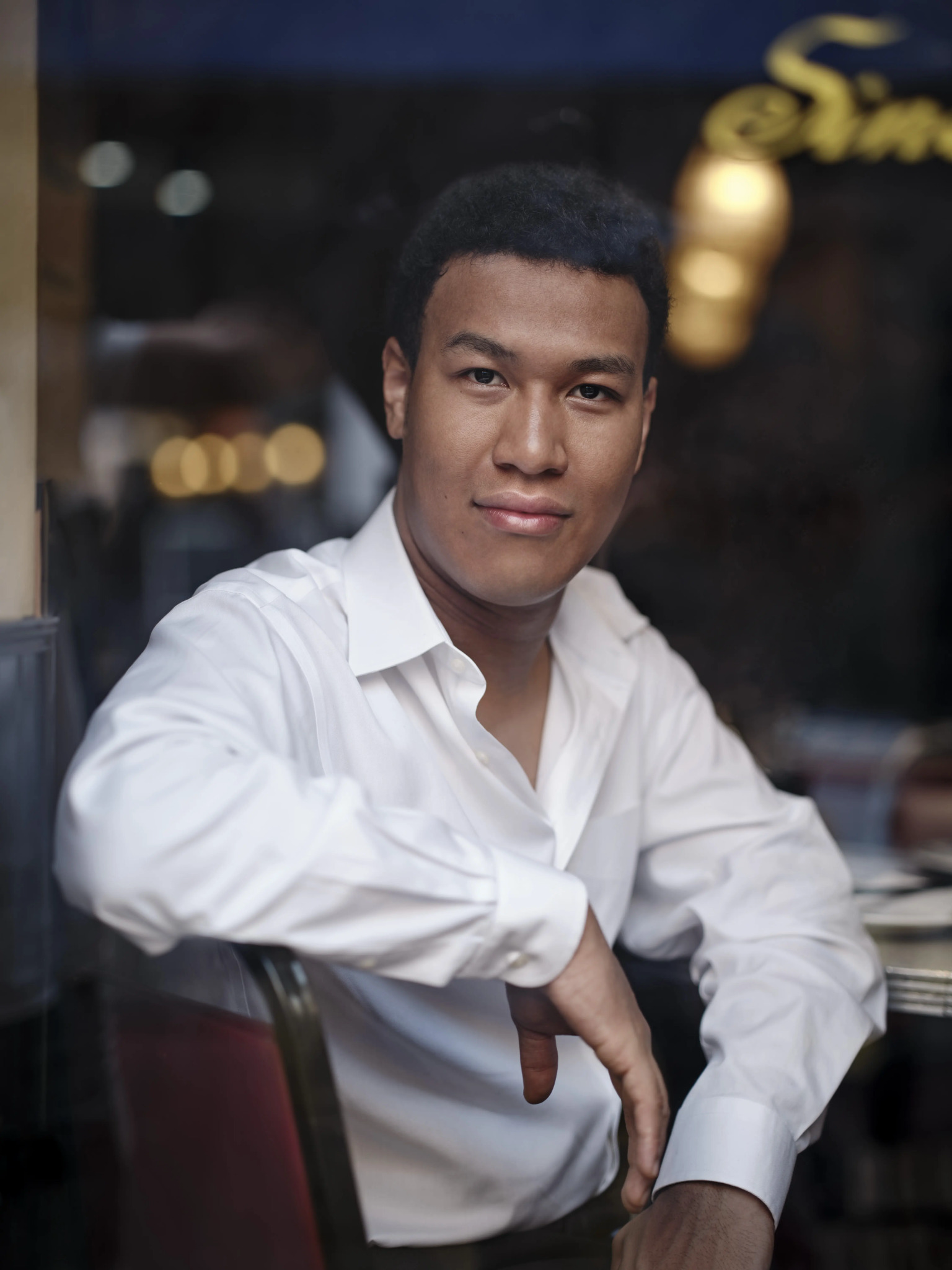 Clayton Stephenson
Piano
Clayton Stephenson
Piano
American pianist Clayton Stephenson's love for music is immediately apparent in his joyous charisma onstage, expressive power, and natural ease at the instrument. Hailed for interpretations that are "fresh, incisive, and characterfully alive" (Gramophone), he is committed to making an impact on the world through his music-making. Growing up in New York City, Clayton found musical inspiration in community programs. As he describes it, the "Third Street Music School jump-started my music education; the Young People's Choir taught me phrasing and voicing; Juilliard's Music Advancement Program introduced me to formal and rigorous piano training, which enabled me to get into Juilliard Pre-College; the Morningside Music Bridge validated my talent and elevated my self-confidence; and the Boy's Club of New York exposed me to Jazz." He received an Avery Fisher Career Grant in 2024 and if a 2025 Sphinx Medal of Excellence honoree. Recent and upcoming highlights include the New York Philharmonic and Houston and Cincinnati Symphony Orchestras; and Grant Park, Washington Performing Arts at the Kennedy Center, Foundation Louis Vuttion, and 92NY.
For more information, visit https://cliburn.org/competitions/relive-past-competitions/2022-cliburn-competition/2022-competition-competitors/clayton-stephenson.
|
Please upgrade

Internet Explorer
|
or try one of these other browsers.
Browsers are free and easy to install.
|
||||
| Upgrade Internet Explorer | What's a browser? Opt out |